Turbo Ventilating System Services In MP
Proper ventilation is an important requirement for factories, warehouses, manufacturing units and large industrial buildings. Heat generated by machinery, production activities, sunlight and limited air circulation can create uncomfortable indoor conditions. A suitable roof ventilation system helps remove accumulated hot air and supports better air movement inside the building.
Rajpoot PEB Creation offers PEB-related building solutions for businesses looking for turbo ventilating system requirements in Madhya Pradesh. Turbo ventilators can be considered for industrial sheds, warehouses, workshops, manufacturing facilities and suitable commercial structures.
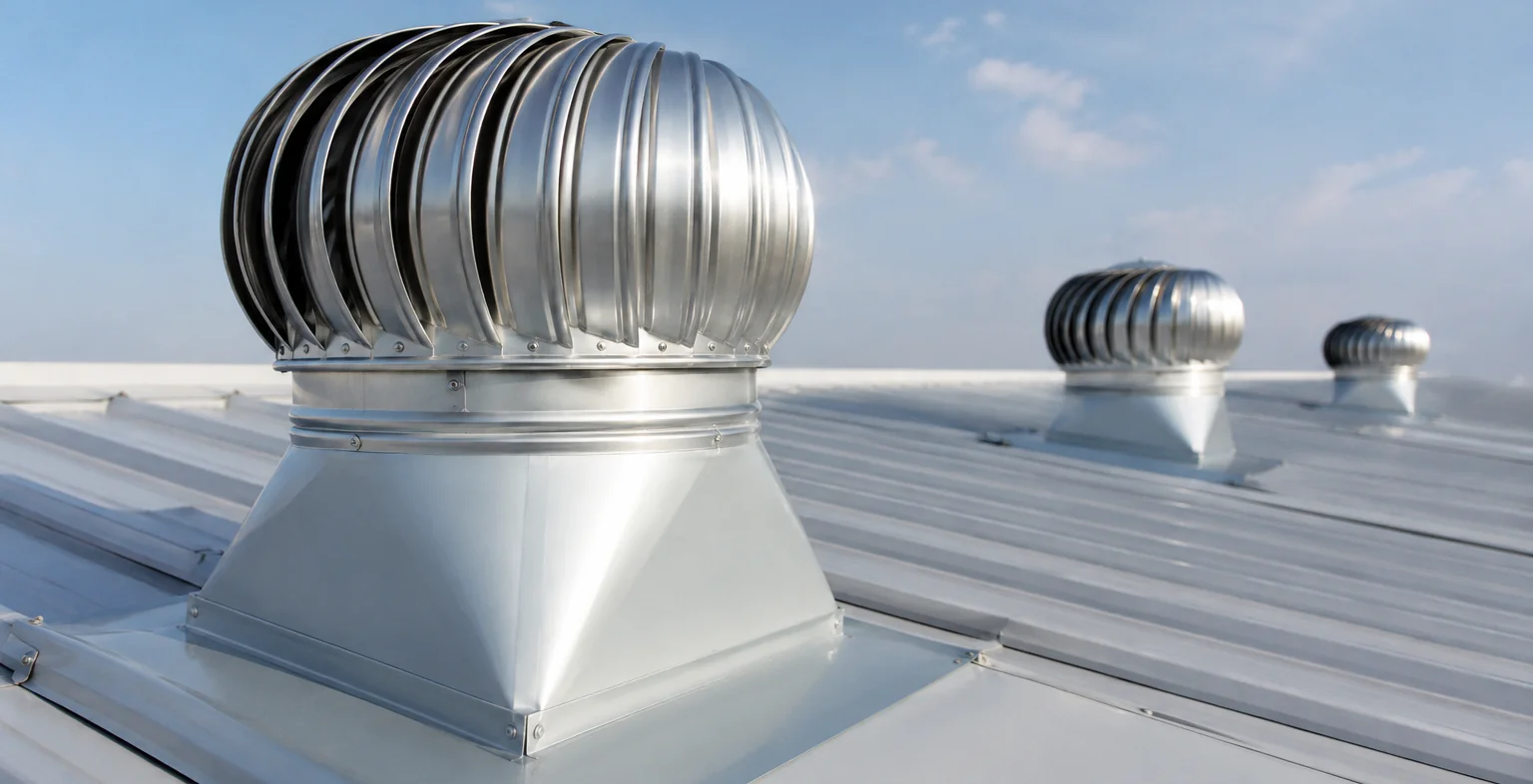
A turbo ventilator is generally installed on the roof to help exhaust warm and stale indoor air. Natural wind-driven models use rotating turbine blades, while powered roof ventilators use an electric motor to extract air. The appropriate system depends on building dimensions, heat generation, roof design, ventilation requirements and site conditions.
Whether you are planning a new factory, industrial shed, warehouse or commercial building, selecting a suitable turbo ventilating system can help improve indoor air movement and support a more comfortable working environment.
What Is A Turbo Ventilating System?
A turbo ventilating system is a roof-mounted ventilation arrangement designed to help remove accumulated hot and stale air from enclosed spaces.
Natural wind-driven turbo ventilators use external wind and natural convection to support air extraction. Their rotating turbine assembly helps draw warm indoor air through the roof opening and release it outside.
A typical turbo ventilator consists of:
-
Rotating turbine head
-
Aerodynamically designed blades
-
Central shaft and bearing assembly
-
Ventilator throat or neck
-
Mounting base or flashing
-
Roof fixing arrangements
-
Weather protection components
-
Compatible roof sealing accessories
The complete ventilation arrangement should also provide suitable openings for fresh air to enter the building.
Benefits Of Turbo Ventilating Systems
1. Hot Air Extraction: Turbo ventilators help remove accumulated warm air from suitable industrial and commercial buildings.
2. Improved Air Circulation: When combined with adequate fresh-air inlets, they support better indoor air movement.
3. Natural Wind-Driven Operation: Natural turbo ventilators generally operate without an electric motor.
4. Industrial Roof Compatibility: Suitable models can be installed on compatible metal roofing and industrial shed structures.
5. Reduced Stale Air Accumulation: Properly planned ventilation helps remove stale indoor air and supports better air exchange.
6. Material Options: Turbo ventilators are available in different construction materials, including aluminium, stainless steel and FRP-based components, depending on the product.
7. Low-Power Ventilation Option: Natural wind-driven models do not require electricity for turbine rotation, although their airflow depends on wind and building conditions.
Applications Of Turbo Ventilating Systems
Turbo ventilating systems can be considered for different industrial and commercial applications, including:
-
Industrial factories and manufacturing units
-
PEB structures and industrial sheds
-
Large warehouses and storage facilities
-
Engineering and fabrication workshops
-
Automobile workshops
-
Textile and garment manufacturing units
-
Packaging and production facilities
-
Commercial buildings
-
Agricultural processing buildings
-
Industrial assembly units
-
Suitable workshops and storage facilities
The correct ventilation arrangement should be selected according to the building's internal conditions and operational requirements.
Types Of Turbo Ventilating Systems & Their Applications In MP
Different roof ventilation systems are available for industrial and commercial buildings. Their selection depends on the required airflow, building design, material specifications, environmental conditions and installation requirements.
1. Natural Wind-Driven Turbo Ventilators
Natural wind-driven turbo ventilators use external wind to rotate the turbine blades and support the extraction of indoor air.
Key Features:
-
Wind-powered rotating turbine assembly
-
No electric motor required for normal rotation
-
Helps exhaust accumulated hot air
-
Suitable for compatible industrial roofs
-
Requires sufficient replacement-air openings
-
Available in different sizes and material options
2. Stainless Steel Turbo Ventilators
Stainless steel turbo ventilators are used in applications where material durability and corrosion resistance are important considerations.
Key Features:
-
Stainless steel body and blade options
-
Corrosion resistance depending on steel grade
-
Rotating turbine assembly
-
Suitable for selected industrial environments
-
Different throat diameters and configurations
The appropriate stainless steel grade should be selected according to the installation environment and product specifications.
3. Aluminium Turbo Ventilators
Aluminium turbo ventilators are lightweight roof ventilation options used in industrial and commercial buildings.
Key Features:
-
Lightweight construction
-
Corrosion resistance characteristics
-
Wind-driven operation in natural models
-
Different sizes and blade configurations
-
Suitable for compatible roof mounting arrangements
4. FRP Turbo Ventilators
FRP (Fibre Reinforced Plastic) turbo ventilators use fibre-reinforced polymer components. They can be considered for selected industrial environments where material selection needs to account for moisture and exposure conditions.
Key Features:
-
Lightweight construction
-
Different base and turbine configurations
-
Material properties depend on resin specifications
-
Suitable for selected industrial applications
-
Compatible roof mounting options
5. Powered Roof Ventilation Systems
Powered roof ventilation systems use electric motors and fans to extract indoor air. These systems may be suitable when more controlled or consistent mechanical air extraction is required.
Key Features:
-
Motor-operated air extraction
-
Defined airflow capacity according to fan selection
-
Suitable for industrial ventilation requirements
-
Electrical connections and controls may be required
-
Can be coordinated with planned fresh-air inlets
6. Industrial Roof Exhaust Ventilators
Industrial roof exhaust ventilators are designed to remove hot air, stale air and selected indoor contaminants from suitable buildings.
They may be considered for:
-
Manufacturing facilities
-
Industrial workshops
-
Warehouses
-
Production units
-
Large metal-roof buildings
The ventilation arrangement should account for the nature of indoor contaminants. Processes involving fumes, dust or hazardous substances may require dedicated mechanical extraction systems rather than general-purpose turbo ventilators.
7. Customized Turbo Ventilation Solutions
Customized turbo ventilation arrangements can be planned according to individual building requirements.
Possible considerations include:
-
Ventilator throat diameter
-
Turbine head material
-
Blade configuration
-
Mounting base design
-
Roof profile compatibility
-
Required airflow capacity
-
Ventilator quantity and spacing
-
Rainwater protection
-
Maintenance access
8. Ridge Ventilation Systems
Ridge ventilators are roof-mounted ventilation arrangements designed to provide continuous or distributed air exhaust along suitable roof sections.
They may be considered for large warehouses and industrial buildings where a broader ventilation arrangement is required.
Important Factors For Selecting A Turbo Ventilating System
Selecting a suitable turbo ventilator requires more than choosing a particular diameter or quantity. Important considerations include:
-
Building length, width and internal height
-
Total building volume
-
Internal heat generation
-
Required air changes per hour
-
Available wind conditions
-
Ventilator airflow performance
-
Number and location of fresh-air inlets
-
Roof profile and supporting structure
-
Ventilator material and blade design
-
Rainwater protection and flashing
-
Roof wind loads and fixing arrangements
-
Maintenance access and safety requirements
Ventilator quantity should be determined through a ventilation assessment rather than a generic floor-area calculation. The building must have sufficient replacement-air openings for effective air extraction.
Turbo Ventilating System Installation Process
A typical turbo ventilator project may involve the following stages:
-
Building Assessment: Reviewing building dimensions, roof height, heat sources and existing ventilation arrangements.
-
Ventilation Requirement Calculation: Evaluating required airflow based on building volume, occupancy, heat load and process requirements.
-
Ventilator Selection: Selecting a suitable ventilator type, material, diameter and expected airflow capacity.
-
Roof Compatibility Check: Checking roof sheets, purlins, structural supports and suitable installation positions.
-
Opening And Base Preparation: Preparing the roof opening and compatible mounting base according to the approved installation details.
-
Ventilator Fixing: Installing the turbine assembly with suitable structural support and fixing arrangements.
-
Weatherproofing: Providing compatible flashing, sealing and drainage details to reduce the risk of water ingress.
-
Final Inspection: Checking turbine rotation, alignment, roof sealing, fixing security and ventilation performance.
Why Choose Rajpoot PEB Creation For Turbo Ventilating System Services In MP?
Choosing an appropriate industrial ventilation arrangement requires coordination between the roof structure, ventilator specifications, airflow requirements and installation details. Rajpoot PEB Creation offers PEB-related building solutions and welcomes enquiries for industrial roofing and ventilation requirements across Madhya Pradesh.
1. Project-Specific Ventilation Requirements
Every industrial building has different dimensions, internal heat sources and ventilation needs. Understanding these requirements helps identify suitable ventilation options.
2. Industrial Building Applications
Turbo ventilators can be considered for factories, warehouses, manufacturing units, workshops and suitable commercial buildings.
3. Different Material Options
Aluminium, stainless steel and FRP-based ventilator options can be evaluated according to project requirements and environmental conditions.
4. PEB Roofing Coordination
Ventilator placement should be coordinated with roof sheets, purlins, structural members and other roofing components to maintain compatibility with the building.
5. Suitable Ventilation Planning
Natural wind-driven ventilators and powered roof exhaust systems serve different purposes. The appropriate option should be selected according to the required airflow and operating conditions.
6. Installation And Weatherproofing Considerations
Roof openings, mounting bases, flashing, fasteners and sealing arrangements require proper attention to support installation quality and reduce leakage risks.
7. Enquiries Across Madhya Pradesh
Based in Rau, Indore, Rajpoot PEB Creation welcomes enquiries for PEB-related building, industrial roofing and ventilation requirements from different cities and industrial locations across Madhya Pradesh. Contact the company to discuss your project requirements and confirm the available service scope.
Turbo Ventilating System Services In Major Cities & Locations Of Madhya Pradesh
Madhya Pradesh has several industrial, commercial and developing business locations where turbo ventilating systems can be considered for factories, warehouses, manufacturing facilities, industrial sheds and commercial buildings.
Rajpoot PEB Creation welcomes enquiries for turbo ventilation and PEB-related building requirements from the following locations, subject to project scope and service availability.
Major Cities Of Madhya Pradesh
Madhya Pradesh, Bhopal, Indore, Jabalpur, Gwalior, Ujjain, Sagar, Dewas, Satna, Rewa, Ratlam, Katni, Singrauli, Burhanpur, Khandwa, Chhindwara, Morena, Bhind, Shivpuri, Vidisha, Guna, Mandsaur, Neemuch, Sehore, Hoshangabad (Narmadapuram), Betul, Itarsi, Harda, Damoh, Panna, Chhatarpur, Tikamgarh, Datia, Ashoknagar, Shajapur, Agar Malwa, Rajgarh, Dhar, Khargone, Barwani, Jhabua, Alirajpur, Balaghat, Mandla, Dindori, Seoni, Narsinghpur, Shahdol, Umaria, Anuppur, Sidhi, Maihar, Sheopur, Raisen.
Industrial And Commercial Locations
Mandideep, Bina, Gadarwara, Pipariya, Nagda, Jaora, Mhow (Dr. Ambedkar Nagar), Pithampur, Rau, Sanwer, Badnagar, Khachrod, Tarana, Berasia, Obedullaganj, Kolar, Budhni, Kannod, Khategaon, Barwaha, Sanawad, Maheshwar, Mandu, Omkareshwar, Dhamnod, Garoth, Suwasra, Jawad, Manasa, Multai, Parasia, Chourai, Waraseoni, Baihar, Lakhnadon, Wara Seoni, Dabra, Bhitarwar, Sabalgarh, Ambah, Porsa, Lahar, Gohad, Mehgaon, Karera, Pichhore, Kolaras, Badarwas, Jaithari, Kotma, Amla, Sarni, Bairagarh.
Location-Based Turbo Ventilation Requirements
-
Indore, Rau, Pithampur and Dewas: Turbo ventilation for industrial sheds, manufacturing units, factories and warehouses.
-
Bhopal and Mandideep: Roof ventilation systems for industrial buildings, commercial facilities and production units.
-
Jabalpur, Katni and Sagar: Industrial roof exhaust ventilation for workshops, warehouses and storage buildings.
-
Gwalior, Morena and Bhind: Turbo ventilating systems for factories, commercial structures and industrial sheds.
-
Ujjain, Nagda and Ratlam: Industrial ventilation arrangements for manufacturing and warehouse facilities.
-
Rewa, Satna and Maihar: Roof ventilation solutions for processing units, workshops and industrial buildings.
-
Dhar, Khargone and Barwani: Industrial roof ventilation and heat-exhaust requirements.
-
Mhow, Sanwer and nearby locations: Turbo ventilation options for workshops, storage buildings and commercial facilities.
Businesses planning a new industrial ventilation system or upgrading an existing factory roof can contact Rajpoot PEB Creation to discuss their project requirements.
Frequently Asked Questions (FAQs)
Q1. What is a turbo ventilating system?
A turbo ventilating system is a roof-mounted ventilation arrangement that helps remove hot and stale indoor air. Natural wind-driven models use rotating turbine blades to support air extraction.
Q2. Do turbo ventilators require electricity?
Natural wind-driven turbo ventilators generally do not require electricity for rotation. Powered roof ventilation systems use electric motors and require an appropriate power supply.
Q3. Where can turbo ventilators be installed?
They may be installed on suitable factory roofs, warehouses, industrial sheds, workshops and selected commercial buildings after checking the roof structure and ventilation requirements.
Q4. Can turbo ventilators help reduce indoor heat?
They can help remove accumulated hot air and improve air movement. However, they do not work like air conditioners, and the actual improvement depends on building conditions, wind availability and fresh-air entry arrangements.
Q5. How many turbo ventilators are required for a factory?
The required quantity depends on building volume, internal heat load, required airflow, ventilator capacity, wind conditions and available air inlets. A ventilation assessment should determine the appropriate quantity and placement.
Q6. Which materials are used in turbo ventilators?
Common material options include aluminium, stainless steel and fibre-reinforced plastic (FRP). The suitable material depends on environmental exposure and product specifications.
Q7. Are turbo ventilators suitable for PEB structures?
They can be considered for compatible PEB structures. Installation must be coordinated with roof profiles, structural supports, purlins, waterproofing details and the roofing manufacturer's recommendations.
Q8. Can turbo ventilators be installed on existing metal roofs?
They may be installed on compatible existing metal roofs after checking the roof profile, supporting structure and installation details. Correct flashing and sealing are essential.
Q9. Do turbo ventilators work during low-wind conditions?
Their performance may reduce when wind speed is low. Natural convection may also contribute to air movement, but actual airflow depends on the building and ventilator design.
Q10. Can turbo ventilators remove industrial fumes and dust?
General-purpose turbo ventilators can support air exchange, but they should not automatically be treated as dedicated fume or dust extraction systems. Industrial processes involving harmful contaminants may require specially designed local exhaust ventilation.
Q11. What factors affect turbo ventilator performance?
Performance depends on wind speed, building height, ventilator diameter, airflow resistance, roof location, internal heat conditions and the availability of fresh-air openings.
Q12. Does Rajpoot PEB Creation accept turbo ventilation enquiries across Madhya Pradesh?
Rajpoot PEB Creation welcomes enquiries from major cities and industrial locations across Madhya Pradesh. Contact the company to discuss your project requirements and confirm the available service scope.
Conclusion
Turbo ventilating systems can support better air circulation and help remove accumulated hot air from suitable factories, warehouses, workshops and industrial buildings. Selecting the right ventilator type, capacity, quantity and installation position is important for achieving the intended ventilation performance.
Rajpoot PEB Creation welcomes enquiries for PEB-related building and industrial ventilation solutions across Madhya Pradesh. Whether you are planning a factory roof ventilation system, warehouse ventilation or an industrial shed, contact the team to discuss your project requirements.